Tanzania vs Kenya safari: an honest answer from Arusha
We should declare our interest before we start. Nature Travel Expedition is a Tanzanian company, run by its two directors from Arusha, and we sell Tanzania safaris. If you want a neutral referee for this question, we are not it. What we can offer instead is an honest one.
Most comparison pieces skip the main thing: the Serengeti and the Masai Mara are not rivals so much as two names for one ecosystem, split by a national border the animals have never noticed. Both countries deliver a superb safari. The differences are real, but they are practical, measurable things that point different travellers in different directions.
So this is our attempt at a fair answer. Where Kenya genuinely wins, we say so. Where Tanzania wins, we say so with slightly more enthusiasm, and you can adjust for the accent.
One ecosystem that ignores the border
The Serengeti and the Masai Mara are a single sweep of grassland that happens to cross a line on a map. Serengeti National Park covers about 14,750 square kilometres in Tanzania; the Masai Mara National Reserve covers about 1,510 square kilometres in Kenya. There is no fence, and the wildebeest, the lions that hunt them and the rain that moves them treat it all as one place.
That single fact deflates most of the shouting on both sides. Roughly nine-tenths of the shared ecosystem lies in Tanzania, which matters for space and for how long the herds spend here. But the Kenyan tenth is a genuinely superb tenth, and pretending otherwise would insult your intelligence.
Where the herds actually are, month by month
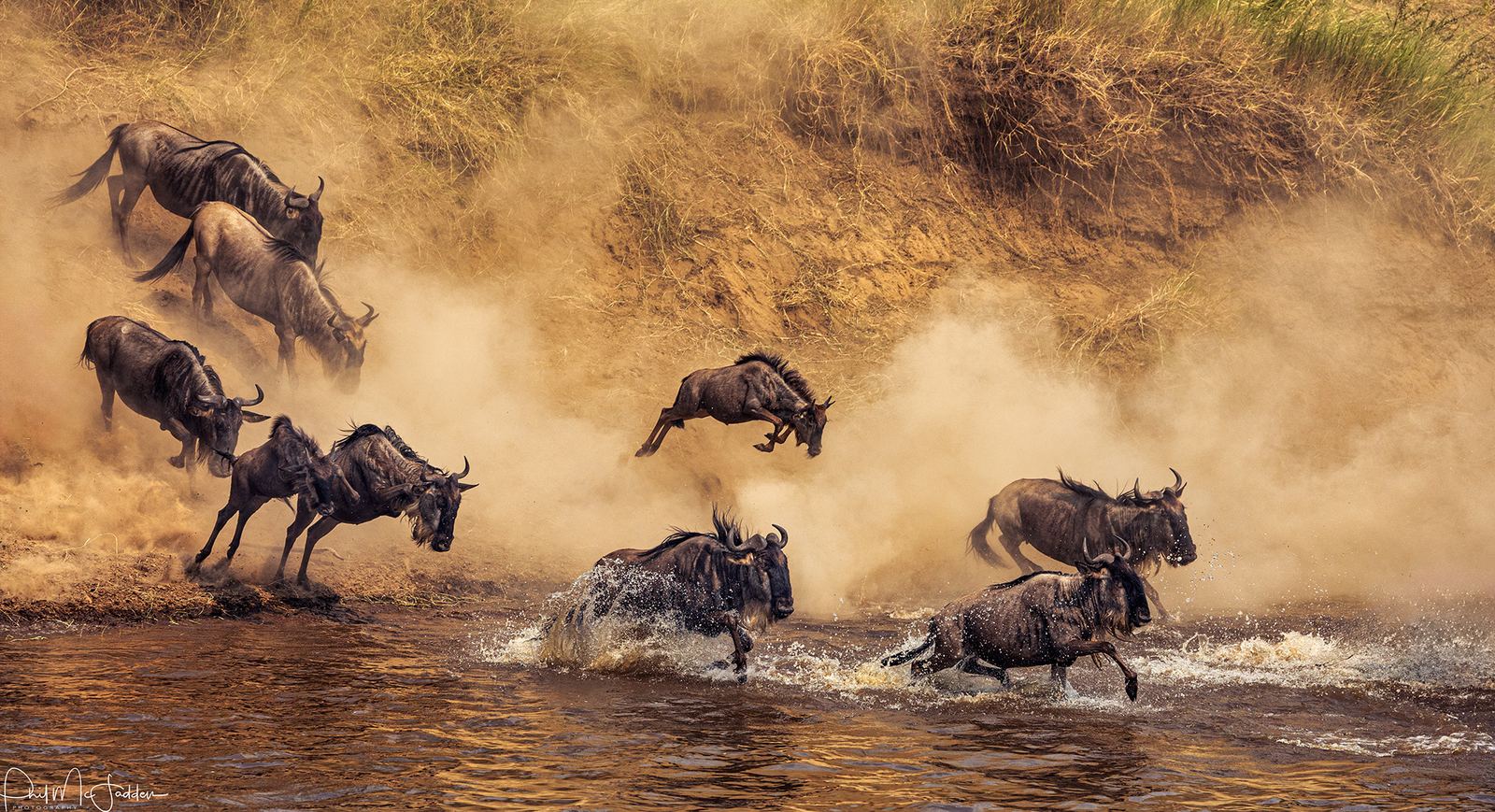
The migration is not an event, it is a year-round circuit of this one ecosystem. The herds are typically in the Masai Mara for the river-crossing months, roughly August into October. For the rest of the year, calving in the south, massing on the plains, pushing west and north, they are in Tanzania.
We keep the full month-by-month picture in our Great Migration guide. The short version: if your dates are fixed to August or September and crossings are the whole point, Kenya positions you very well. In most other months, the herds are on our side of the line.
Worth knowing: the Mara River runs through the northern Serengeti too, and crossings happen on both banks. August in Tanzania is not a consolation prize.
The case for Kenya, made honestly
Kenya's biggest advantage is proximity. Nairobi to the Masai Mara is about 225 kilometres, typically five and a half to six and a half hours by road, or a short scheduled flight. Land in the morning and you can be watching lions by late afternoon, which matters on a one-week holiday.
Kenya also has a denser lodge market. More properties compete in and around the Mara than in any comparable slice of the Serengeti: more choice at every budget, better odds of a last-minute bed. Nairobi is a bigger flight hub than Kilimanjaro too, with more direct long-haul routes.
And Amboseli gives Kenya the famous postcard of elephants beneath Kilimanjaro. We enjoy pointing out that the mountain itself stands in Tanzania, but the view is undeniably from Kenya.
The case for Tanzania, argued from home
Our side starts with scale. The Serengeti spreads its visitors across an area nearly ten times the Mara's, so away from the famous crossing points you can watch a hunt unfold with no other vehicle in sight. Space is not a luxury on safari; it is the difference between watching wildlife and queueing for it.
Then there is the calendar. Because most of the ecosystem is Tanzanian, the herds spend most of the year here, which frees you to travel in quieter, cheaper months without missing them. And Ngorongoro Crater has no equivalent in Kenya or anywhere else: a collapsed volcano whose floor holds one of the densest concentrations of large animals in Africa.
Finally, variety. Tarangire's elephant herds, Lake Manyara, the crater and the Serengeti all sit on one road circuit out of Arusha, so a single week in Tanzania passes through four distinct landscapes without an internal flight.
What the gates charge in 2026
Park fees are public, so we can compare them plainly. The Masai Mara charges non-resident adults $200 per day in high season, July through December, and $100 per day from January through June. Children aged nine to seventeen pay $50.
On our side, Serengeti entry for a non-resident adult is a little over $80 per day including VAT, and Tarangire and Lake Manyara are $59 each. Ngorongoro charges about $84 per person per 24 hours, plus vehicle fees and a crater descent fee of just under $350 per vehicle.
So at the height of the season, the Mara's gate costs more than double the Serengeti's, though Ngorongoro's vehicle fees claw some of that back on crater day. Operators in both countries pass these fees through at cost; be wary of any quote that does not itemise them.
The rest of the bill looks much the same
Beyond the gate, the two countries price safaris the same way: a private 4x4 with a driver-guide charged by the day, lodges tiered from camping to serious luxury, with fuel and park fees on top. Comparable trips at a comparable comfort level land within touching distance of each other.
Kenya's crowded lodge market produces some sharp mid-range deals; Tanzania's longer distances can add a vehicle day or an internal flight. We have broken down where the money actually goes in our Tanzania safari cost guide, and most of it applies, line for line, to Kenya as well.
Drive times, told straight
We publish honest drive times, not map-app fantasies, because Tanzanian law caps licensed passenger vehicles at 80 kilometres per hour and the police enforce it. From Arusha, a law-abiding driver reaches Tarangire in two to two and a half hours, Lake Manyara in about three, the Ngorongoro gate in three to four, and the central Serengeti in eight to ten hours by road.
That last number is the fair price of the Serengeti's size. Many of our guests fly one way to the airstrips, or break the journey at the crater. Kenya's short run to the Mara is a real advantage, and we would rather tell you so than have you discover it.
The border, step by step
The part that surprises people: you cannot game-drive from the Serengeti into the Mara. The crossing points inside the ecosystem are closed to tourist traffic, so moving between the parks means leaving one, driving to the Namanga border on the Arusha to Nairobi road, and entering the other country there.
Namanga is a one-stop border post, and it works. Arusha to Namanga takes about two hours, formalities take 30 to 90 minutes depending on the queue, and Arusha to Nairobi is a five to seven hour day door to door. We run this route ourselves through our transfer service, so we can hand you from one side to the other without a gap.
Visas, permits and the small print
Kenya has replaced its tourist visa with an electronic travel authorisation, currently $30, applied for online before you fly. Tanzania issues its own eVisa at $50 for most nationalities and $100 for US citizens.
Watch out for the East Africa Tourist Visa. It costs $100 and sounds like the obvious answer for a two-country trip, but it covers Kenya, Uganda and Rwanda only. Tanzania is not part of it, so this combination always needs two separate documents. Officials at Namanga can also ask for a yellow fever certificate when you enter Tanzania overland, so raise it with your travel clinic well before you go.
Doing both in one trip
For travellers with time, the honest answer to this whole article is both. A classic loop lands in Nairobi, takes the Mara first, crosses at Namanga, then runs Tanzania's northern circuit and flies home from Kilimanjaro. It reads as one continuous safari with a paperwork interlude in the middle.
The border day is a travel day, so the combination only earns its keep with enough time on either side. We would want ten days as a floor and twelve to fourteen to do it comfortably; our thinking on trip length is in how many days a Tanzania safari needs, and the same logic stretches across the border.
How we would decide
If your dates are locked to August or September, you have a week or less, and river crossings are the dream, Kenya has a fair claim on you, though the northern Serengeti watches the same river from the opposite bank.
If you can travel in any other month, if the crater is on your list, or if it is your first safari and you want four landscapes in one unhurried circuit, we think Tanzania is the stronger trip. If you have ten days or more, stop choosing and do both.
And yes, we are Tanzanian, so weigh our verdict accordingly. But notice that the first rule we gave you sends people to Kenya. We would rather you trust us and book the right trip than flatter us and book the wrong one.
Frequently asked questions
Is the Masai Mara part of the Serengeti?
Ecologically, yes. The Mara is the northern, Kenyan section of the same unfenced Serengeti-Mara ecosystem, and the wildebeest move between the two freely. Administratively they are separate: Serengeti National Park is Tanzanian and covers about 14,750 square kilometres, while the Masai Mara National Reserve is Kenyan and covers about 1,510. You pay separate park fees, need separate travel documents, and cannot drive directly from one into the other.
Which is cheaper, a safari in Kenya or Tanzania?
At the same comfort level, totals usually land close together. Gate fees differ sharply by season: the Masai Mara charges non-resident adults $200 per day in high season against a little over $80 for the Serengeti, while Ngorongoro adds hefty vehicle fees on crater day. Kenya's dense lodge market throws up sharp mid-range deals; Tanzania's distances can add a vehicle day or a flight. Compare whole itineraries, not headline prices.
Can you drive from the Serengeti into the Masai Mara?
No. Although the two parks meet inside the ecosystem, the crossing points there are closed to tourist traffic. To move between them you exit the park, cross at the Namanga border post on the Arusha to Nairobi road, and re-enter on the other side. Budget a full travel day: Arusha to Nairobi runs five to seven hours door to door, including border formalities of 30 to 90 minutes.
Do I need separate visas for Kenya and Tanzania?
Yes. Kenya requires an electronic travel authorisation, currently $30, applied for online. Tanzania issues its own eVisa at $50 for most nationalities and $100 for US citizens. The $100 East Africa Tourist Visa does not help here: it covers Kenya, Uganda and Rwanda but not Tanzania. Apply for both documents before you travel and carry printed copies for the land border.
Where is the Great Migration in August?
Usually at the northern end of the ecosystem, around the Mara River. That means the Masai Mara in Kenya and the northern Serengeti in Tanzania at the same time; the river runs through both, and crossings happen on both banks. From roughly November the herds swing back south into Tanzania, where they remain, calving and massing on the plains, for most of the year.
Is Kenya or Tanzania better for a first safari?
Both work well, so let your constraints decide. With a week or less and a fixed August or September window, Kenya's quick access to the Mara is hard to beat. With more flexibility, we would argue for Tanzania: Tarangire, Ngorongoro and the Serengeti give a first-timer four distinct landscapes in one road circuit, and the herds are here for most of the year. Travelling for ten days or more, combine the two.
Put the question to us
Tell us your dates, who is travelling and how many days you have, and the two of us will tell you honestly which side of the border they point to, including when the answer is Kenya, or both. Every quote is prepared per booking, in writing, with park fees itemised.
Plan your safari